
















The Analog Edit: 5 Out-of-the-Box Ways to Reset Your Sense of Time
Most “offline” advice sounds the same.
Go for a walk. Read a book. Light a candle.
Let’s try something different.
Here are a few analog experiments you can actually try this weekend — all grounded in psychology and neuroscience — designed to stretch your sense of time and make it feel richer, slower, and more memorable.
.jpg)
1. Manipulate Time on Purpose (The Novelty Effect)
The science:
Our brains measure time by storing memories. The more novel details you experience, the longer a period feels in retrospect. This is known as the novelty effect in memory research. Routine compresses time. Newness expands it.
Try this:
Rearrange one room completely differently.
Change the order of your morning routine.
Use your non-dominant hand for daily tasks for two hours.
Take a completely unfamiliar route somewhere — even inside your own neighborhood.
The goal isn’t productivity. It’s unfamiliarity. Novelty forces the brain to pay attention, which creates denser memory encoding. Dense memory makes time feel longer in hindsight.
By Sunday night, the weekend will feel surprisingly full.
2. Do a “Single-Task Sprint” (Deep Focus Reset)
The science:
Research on attention shows that multitasking increases cognitive fatigue and reduces memory formation. Deep, uninterrupted focus improves satisfaction and strengthens engagement.
Try this:
Pick one physical task. Sorting old printed photos. Organizing a drawer perfectly. Assembling something slowly. Hand-polishing wood or metal.
Set a watch for 45 minutes. No music. No phone nearby. No switching tasks.
Your brain will resist at first. Then it settles. After about 15 to 20 minutes, attention stabilizes. That’s when time starts feeling immersive instead of fragmented.
Flow states stretch the subjective experience of time.

3. Lower the Stimulation Baseline (Dopamine Contrast)
The science:
Constant stimulation raises your dopamine baseline. When everything is intense, nothing feels intense. Reducing stimulation temporarily increases sensitivity to simple pleasures.
Try this for one afternoon:
No background music.
No bright artificial lighting.
No snacking out of boredom.
No checking the time unless necessary.
Sit in a quiet room. Do something mildly boring.
At first, your brain will search for stimulation. Then it settles. Later that evening, small things — a warm drink, a conversation, even silence — feel sharper.
You reset your internal contrast.
4. Slow Down Your Movements Deliberately (Motor Tempo Shift)
The science:
Movement speed influences perceived time. When we rush physically, our internal clock speeds up. Slower motor behavior signals safety and reduces stress levels.
Try this experiment:
For one hour, walk 20% slower than usual.
Eat 20% slower than usual.
Speak slightly slower.
Make gestures more deliberate.
Not exaggerated. Just intentional.
You’ll notice something subtle: your thoughts begin to slow as well. Body tempo influences mental tempo. Time feels less like it’s pushing you forward.
5. Create a Memory Anchor (Future Recall Trick)
The science:
We remember events better when we consciously mark them as important in the moment. Psychologists call this event segmentation. It increases how long an experience feels in hindsight.
Try this Saturday evening:
Pause randomly at some point. Look at your surroundings for ten seconds.
Notice a sound.
Notice a texture.
Notice one specific visual detail.
Then tell yourself internally: “I want to remember this moment.”
That simple mental note dramatically increases the chance you’ll recall it later.
You didn’t change the moment. You simply decided it mattered.
Why This Works
Time doesn’t speed up because clocks move faster. It speeds up because attention fragments and novelty disappears.
When days feel identical, memory compresses them. When experiences are distinct and intentional, time expands.
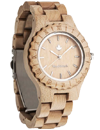
An analog watch doesn’t interrupt or demand attention. It simply marks movement steadily and quietly.
What changes the feeling of time isn’t the clock.
It’s how deliberately you live between each tick.
This weekend, don’t just unplug.
Experiment.